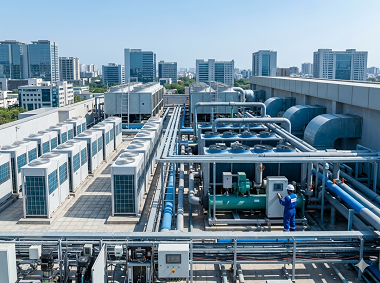
When it comes to commercial and industrial spaces, your Heating, Ventilation, and Air Conditioning (HVAC) system is far more than just a thermostat on the wall. It is the absolute beating heart of your facility’s comfort, safety, and operational efficiency. In fact, commercial HVAC systems typically account for up to 40% of a building’s total energy consumption.
Whether you are upgrading an outdated plant room, setting up a new corporate office, or designing a complex clean-room environment, choosing the right HVAC infrastructure is a critical investment. The system you choose today will dictate your facility’s utility bills, maintenance costs, and air quality for the next 15 to 20 years.
At Quality Aire Solutions, we’ve spent over a decade helping businesses across India navigate these complex engineering choices. Before you sign off on your next facility upgrade, here are the six crucial factors you must consider to ensure you select the perfect commercial HVAC system.
1. Accurate Thermal Load & Capacity Sizing
The biggest and most expensive mistake facility managers make is “guesstimating” the required cooling tonnage based purely on the square footage of the building. Sizing an HVAC system incorrectly has severe, long-term consequences:
- Oversized Systems: Will “short-cycle” (turn on and off too rapidly). This wastes massive amounts of electricity, drastically shortens the lifespan of the compressor, and fails to properly dehumidify the space, leading to a clammy environment and potential mold growth.
- Undersized Systems: Will run continuously at maximum capacity in a futile attempt to reach the set temperature, skyrocketing your power bills and causing premature equipment burnout.
QAS Pro Insight
Before selecting any equipment, you need an exact Thermal Load Analysis. Our engineers calculate your building’s specific volume, ceiling heights, insulation values, peak occupancy levels, geographical solar exposure, and the sensible heat generated by manufacturing machinery or heavy IT equipment to determine the perfect tonnage.
2. Choosing the Right Technology for Your Space
There is no “one-size-fits-all” solution in commercial climate control. The right technology depends entirely on your specific industry application, budget, and architectural constraints:
- VRF/VRV Systems (Variable Refrigerant Flow): Perfect for corporate offices, premium residential spaces, and hospitality. VRF technology allows for independent, multi-zone control. This means you can actively cool a crowded boardroom while simultaneously turning down the AC in an empty cabin, yielding up to 40% in energy savings.
- Central Chiller Plants: The undisputed go-to solution for massive retail malls, heavy manufacturing units, and sprawling IT parks that require heavy-duty, uninterrupted, high-capacity cooling over vast areas.
- Precision Air Conditioning (PAC): Mandatory for data centers, UPS rooms, and laboratories. In these mission-critical environments, even a 1-degree temperature fluctuation or slight humidity shift can cause catastrophic equipment failure.
- Ductable & Packaged ACs: Ideal for showrooms, restaurants, and banquet halls where uniform airflow and aesthetic integration (hiding the units entirely in false ceilings) are top priorities.
3. Indoor Air Quality (IAQ) and Specialized Ventilation
Comfort is important, but occupant safety is paramount. Your HVAC system must do more than just recirculate cool air; it must actively clean and replenish it. Poor ventilation directly leads to “Sick Building Syndrome,” which severely impacts employee health, focus, and productivity.
Especially in industrial manufacturing, food processing, and healthcare settings, specialized ventilation systems are legally and operationally required. Your system design must incorporate proper fresh air intake (Air Changes per Hour – ACH), targeted spot exhaust for heat-generating machinery, and high-grade HEPA filtration or scrubbers to extract harmful fumes, airborne dust, and pathogens. Always ensure your design complies with ASHRAE standards and the National Building Code (NBC) of India.
4. Energy Efficiency & Smart Automation (BMS)
When evaluating commercial HVAC systems, you must analyze the Lifecycle Cost rather than just the upfront capital expenditure. Opting for cheaper, less efficient equipment upfront will cost you exponentially more in monthly utility bills over the system’s lifetime.
To maximize your Return on Investment (ROI), look for systems equipped with high-efficiency inverter compressors and environmentally friendly refrigerants (like R32 or R410A). Furthermore, the modern gold standard is to integrate your HVAC network with a Building Management System (BMS). Smart automation allows facility managers to schedule cooling based on occupancy sensors, monitor real-time energy metering, and receive predictive maintenance alerts directly to their smartphones before a breakdown even occurs.
Sustainability Matters
If your company is aiming for LEED or IGBC (Indian Green Building Council) certification, your HVAC design and automation strategy will be the largest contributing factor to achieving your sustainability rating.
5. Professional Turnkey Execution & Accountability
Even the most expensive, top-tier HVAC equipment in the world will fail miserably if it is installed poorly. Precision nitrogen-purged copper brazing, leak-proof drain piping, structural vibration-isolated mounting, and NBC-compliant fire damper integrations require highly trained mechanical experts.
By partnering with a comprehensive HVAC Turnkey Solutions Provider like Quality Aire Solutions, you get a single point of accountability. Dealing with separate vendors for design, procurement, and installation often leads to blame games and project delays. Having one expert team manage the entire lifecycle—from the initial 3D BIM (Building Information Modeling) blueprinting to the final commissioning and airflow balancing—guarantees flawless execution and zero hidden cost overruns.
6. Long-Term Maintenance and After-Sales Support
Commercial HVAC systems run under immense operational strain. Purchasing and installing the system is only the first step; maintaining it ensures it reaches its full, intended operational lifespan without major capital repairs.
Always partner with a provider that is authorized by major brands. As a proud STAR League partner of Blue Star, Quality Aire Solutions ensures that our clients have direct, prioritized access to genuine spare parts, extended manufacturer warranties, and rapid-response emergency support via our specialized Annual Maintenance Contracts (AMCs).