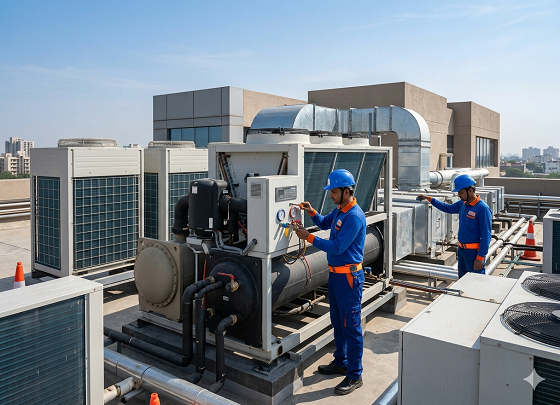
The Ultimate Guide to VRF Systems: Revolutionizing Commercial Cooling

For decades, commercial building owners faced a difficult choice: install a massive, energy-hungry central chiller plant, or scatter multiple inefficient split ACs across the property. Enter VRF (Variable Refrigerant Flow) systems—a technological leap that has completely transformed how we approach commercial climate control.
Originating in Japan, VRF technology has rapidly become the gold standard for office buildings, luxury hotels, premium residential complexes, and hospitals across India. But what exactly makes VRF so superior to traditional HVAC setups?
1. Unmatched Energy Efficiency
Traditional HVAC systems operate on a simple binary: they are either 100% on or completely off. When a room reaches the desired temperature, the compressor shuts down, only to violently kick back on a few minutes later. This constant stop-start cycle wastes an incredible amount of electricity.
VRF systems utilize advanced Inverter Compressors. Instead of shutting down, the compressor dynamically adjusts its motor speed to match the exact cooling demand of the building. By supplying only the precise amount of refrigerant required to cool a specific zone, VRF systems operate continuously at lower, highly efficient speeds.
Proven Cost Reductions
Because VRF systems eliminate compressor power spikes and utilize heat recovery technologies, facilities upgrading from legacy HVAC systems often see their monthly electricity bills drop by an astounding 30% to 40%.
2. Independent, Multi-Zone Control
In a typical corporate office, the IT server room requires heavy cooling, the sun-facing conference room gets stiflingly hot, and the interior executive cabins are freezing cold. A traditional central AC system struggles to accommodate these varying needs, resulting in the dreaded “thermostat wars.”
A VRF system solves this by connecting multiple indoor units to a single outdoor compressor. Each indoor unit has its own thermostat and electronic expansion valve. This allows you to independently control the temperature of every single room. You can even turn off the AC entirely in unoccupied zones without affecting the rest of the building.
- Heat Recovery VRF: The most advanced VRF systems can actually extract heat from a server room and transfer it to a zone that requires heating, providing simultaneous heating and cooling from the same system!
3. Space-Saving Architectural Design
Commercial real estate in India is expensive. Traditional central duct systems require massive mechanical rooms, heavy water pumps, cooling towers, and vast false ceilings to hide bulky metal ductwork.
VRF systems are incredibly compact. They use narrow copper piping instead of massive air ducts to distribute cooling. The outdoor units have a remarkably small footprint and can fit onto standard service balconies or crowded rooftops. This frees up valuable square footage and allows architects to design higher, more aesthetically pleasing ceilings.
4. Whisper-Quiet Operation
There is nothing worse than trying to conduct a meeting over the deafening roar of an air conditioning vent. Because VRF indoor units don’t rely on massive central blowers pushing air through miles of metal ductwork, they operate at a fraction of the noise level. Furthermore, the loud compressor unit is located entirely outside the building, ensuring your workspaces remain whisper-quiet.
5. Scalability and Seamless Installation
Building an entirely new commercial space? Expanding your current office? VRF systems are inherently modular. You can easily add new indoor units to the network as your business expands.
Moreover, the installation process is significantly cleaner and faster than traditional chiller setups. Because there is no need to install heavy chilled-water pipes or massive ducts, VRF networks can be retrofitted into historic buildings or active offices with minimal disruption to daily operations.